
General
The purpose of this article is to explain the term "KVM" and its function. The Sippy Support Department may request KVM access from customers in order to remotely access a server — even if the server is brand new and does not yet have an operating system installed.
KVM access is required for Sippy Support to access your server for installation and upgrades.
Terms
The naming for Remote Access Control Devices may variate depending on brand of device which provides a remote control to server. See the most popular naming:
KVM, iLO, iDRAC, and IPMI are all related to server management, but they serve different purposes. IPMI is a standard for out-of-band server management, while iDRAC and iLO are specific implementations of IPMI by Dell and HP, respectively. KVM (Keyboard, Video, Mouse) is a technology for remotely accessing and controlling a server's console, which can be used in conjunction with IPMI or iDRAC/iLO
Where can I get/find the "KVM"?
The server owner may check the server specifications and see if it supports the Remote Access Control. The naming of device depends on server's brand (eg Dell uses the iDRAC naming, HP - iLO etc).
How to configure the "KVM" device?
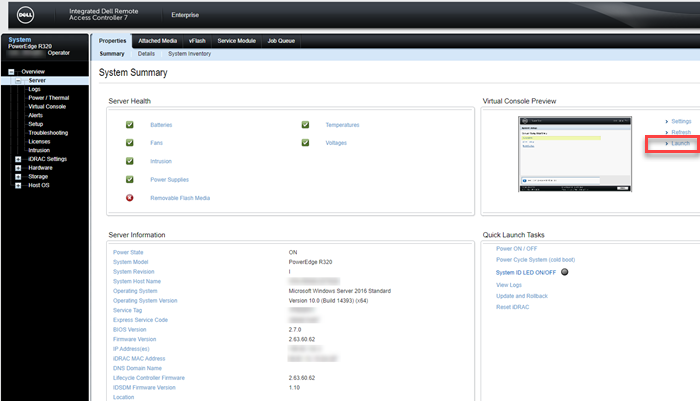
The iDRAC/iLO is an integrated to server device which has a separate lan port and separate IP for the access to the web interface of the device.
Here it is an example of the web UI on iDrac:
How to access it?
In most cases the access to the KVM device is done via the allocated for it IP address. Usually this is a web URL like https://1.1.1.1/. Once the IP is configured by data centre for the server's remote control device, the owner may try to login on it by IP which data centre has allocated for this device.
How to determine if my server has KVM access?
1. Ask data centre support.
2. Check by the model of server the HW specification. In the HW specification try to find the information about iDrac/ILo etc.